








When Sea Routes Fail: Catastrophic Maritime Incidents,...
When Sea Routes Fail: Catastrophic Maritime Incidents, Conflict Zones, and Global Trade Disruption
Global shipping is often described as the invisible engine of international trade. More than 80% of world merchandise trade by volume is transported by sea, making maritime transportation one of the most essential pillars of the global economy. Despite its efficiency and scale, the maritime system remains highly vulnerable to disruption. A single catastrophic marine casualty or conflict in a strategic sea lane can trigger ripple effects far beyond the shipping industry, affecting supply chains, commodity prices, insurance markets, and geopolitical stability.
In recent years, the maritime sector has witnessed several events that exposed the fragility of global shipping networks. Groundings, collisions, oil spills, infrastructure failures, and armed conflicts in maritime chokepoints have collectively demonstrated that shipping disruptions are no longer isolated operational incidents; they are systemic global risks (Arıcan, 2025).
From the blockage of the Suez Canal by the Ever Given to attacks on merchant vessels in the Red Sea and operational instability in the Black Sea, maritime disruptions have increasingly become matters of economic security.
Maritime Casualties as Global Economic Events
Traditionally, marine casualties were viewed primarily through a safety or environmental lens. Ship collisions, groundings, and machinery failures were investigated to improve navigational safety, prevent pollution, and enhance operational procedures. However, the scale of modern maritime trade has transformed major accidents into global economic events.
One of the most striking examples is the Ever Given grounding in March 2021. The ultra-large container vessel became grounded in the Suez Canal during adverse weather conditions, effectively blocking one of the world’s most critical trade arteries for nearly a week. The consequences were immediate and severe.
Hundreds of vessels accumulated at both entrances of the canal, including container ships, crude oil tankers, LNG carriers, and bulk carriers. Delayed cargoes disrupted manufacturing schedules, retail inventories, and commodity flows across Europe, Asia, and the Middle East.
The incident demonstrated a fundamental reality: efficiency-driven supply chains are highly dependent on uninterrupted maritime flow.
A disruption lasting only a few days generated billions of dollars in estimated economic losses, increased freight uncertainty, and reignited discussions regarding route dependency and chokepoint vulnerability.
Similarly, the 2024 collapse of the MV Dali Baltimore bridge collision after the containership Dali struck critical infrastructure highlighted another dimension of catastrophic maritime risk.
Although the incident occurred within a port approach rather than an international chokepoint, its implications extended well beyond local operations. The closure of the Port of Baltimore affected automotive shipments, bulk cargo operations, and regional logistics networks. It also raised urgent questions regarding aging port infrastructure, vessel emergency preparedness, and navigational risk management in constrained waterways.
These incidents reveal that maritime casualties can disrupt not only sea routes but also landside logistics ecosystems.
Environmental Disasters and Regulatory Consequences
Some catastrophic maritime incidents generate consequences that extend beyond operational disruption into environmental, legal, and reputational domains.
The Exxon Valdez oil spill remains one of the most influential maritime environmental disasters in history. The tanker grounding in Alaska released millions of gallons of crude oil into ecologically sensitive waters, causing long-term environmental damage and public outrage.
The disaster triggered regulatory reforms, including stricter tanker construction requirements and the accelerated adoption of double-hull standards.
Environmental disasters create a dual burden for shipping. First, they generate direct financial liabilities through cleanup costs, compensation claims, and legal penalties. Second, they accelerate regulatory tightening. In modern shipping, a major pollution event no longer affects only one company or vessel owner. It can reshape technical standards, operational procedures, and compliance expectations across the industry.
As environmental awareness and ESG expectations continue to grow, catastrophic pollution incidents increasingly influence investor sentiment, insurer risk models, and stakeholder confidence.
Conflict Zones and Maritime Security Risks
If accidents reveal operational fragility, maritime conflict zones expose geopolitical fragility.
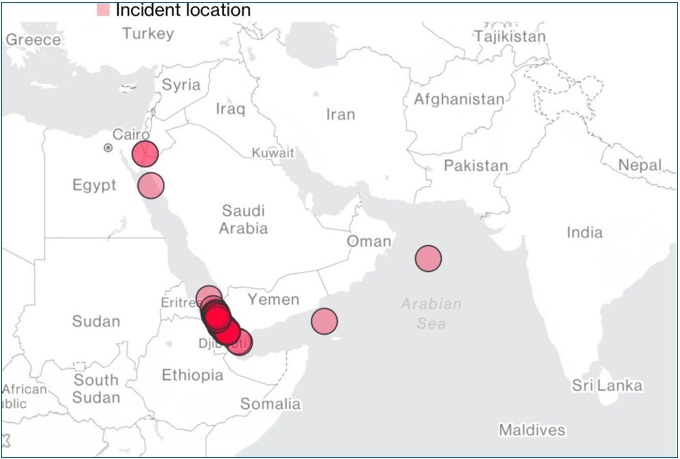
Recent attacks against merchant vessels in the Red Sea have significantly altered global trade patterns. The Red Sea crisis introduced a new layer of security uncertainty to one of the world’s most strategically important maritime corridors.
Commercial ships transiting near the Bab-el-Mandeb Strait and toward the Suez Canal faced missile, drone, and armed attack risks. For shipowners and charterers, the operational calculation changed dramatically.
The shortest route was no longer the safest route.
As a result, many operators diverted vessels around the Cape of Good Hope, adding thousands of nautical miles to voyages between Asia and Europe.
This rerouting generated several consequences:
• increased bunker consumption,
• longer transit times,
• reduced effective fleet capacity,
• schedule unreliability,
• higher freight rates.
War risk insurance premiums surged, and underwriters became increasingly cautious regarding transit approvals. The maritime industry effectively absorbed geopolitical risk through operational inefficiency. A similar dynamic has been observed in the Black Sea following the Russo-Ukrainian War.
The conflict severely disrupted grain exports, increased mine-related navigational risks, and created uncertainty surrounding safe passage arrangements. Given the Black Sea’s importance for agricultural exports, especially wheat and corn, shipping instability directly affected food security and commodity pricing in import-dependent regions.
This highlights an important truth: maritime conflict is no longer merely a regional issue. It is a global economic transmission mechanism.
Strategic Maritime Chokepoints Under Pressure
Several maritime corridors are disproportionately important to global trade.
These include:
• Suez Canal
• Panama Canal
• Strait of Hormuz
• Bab-el-Mandeb Strait
• Strait of Malacca
Disruptions in these locations create outsized consequences because they function as maritime bottlenecks. A grounding, collision, infrastructure failure, drought, or military escalation in these areas can rapidly constrain trade flows. For example, reduced transit capacity in the Panama Canal due to drought conditions demonstrated that even climate-related factors can create chokepoint instability. Therefore, the concept of maritime disruption must be broadened beyond collision or grounding events. Modern shipping faces a multidimensional threat environment including:
• navigational accidents,
• cyber threats,
• armed conflict,
• climate constraints,
• infrastructure fragility.
Insurance, Freight, and Commercial Volatility
One of the most immediate consequences of catastrophic maritime events is commercial volatility. Marine insurance markets respond rapidly to elevated uncertainty.
After major casualties or conflict escalation, shipowners may face:
• increased hull and machinery premiums,
• higher P&I exposure,
• war risk surcharges,
• more restrictive underwriting conditions.
These costs are ultimately embedded into freight markets. Freight rates often surge not only due to physical disruption, but because uncertainty itself has economic value. A delayed vessel, rerouted voyage, or temporarily inaccessible port reduces system efficiency. When enough inefficiencies accumulate, global shipping capacity tightens.
This was clearly visible after both the Ever Given incident and Red Sea disruptions.
Container freight rates rose significantly as longer voyage durations reduced available vessel supply. In effect, catastrophic events can create artificial scarcity within shipping networks.
Crew Safety and Human Factors
Beyond economic and strategic considerations, catastrophic maritime incidents also carry human consequences. Crew members operating in conflict-prone waters face elevated psychological and physical risk. Extended rerouting increases voyage duration, fatigue exposure, and operational stress.
In casualty scenarios, crews are often the first exposed to danger yet the least visible in public narratives. Maritime resilience therefore cannot be discussed solely in terms of infrastructure and trade.
Human factors remain central.
A fatigued crew operating under commercial pressure in congested or high-risk waters increases the probability of operational error. Thus, the relationship between safety, security, and human performance is becoming increasingly interconnected.
Strategic Lessons for the Future
The growing frequency and visibility of catastrophic maritime disruptions offer several lessons for the shipping industry. First, resilience must complement efficiency. Shipping networks optimized exclusively for cost minimization are highly vulnerable to disruption. Second, route diversification is increasingly strategic. Operators must develop realistic contingency planning for chokepoint failure scenarios. Third, maritime security is now inseparable from commercial planning. Voyage planning increasingly requires geopolitical awareness, intelligence monitoring, and dynamic risk assessment. Fourth, infrastructure and regulatory preparedness must evolve.
Ports, canals, and maritime authorities must reassess crisis response capabilities in light of larger vessels, denser traffic, and emerging threats.
Catastrophic maritime incidents and conflicts in strategic sea lanes are no longer isolated operational concerns. They are systemic disruptions with consequences extending across trade, energy, food security, logistics, and geopolitics. From vessel groundings and infrastructure collisions to armed attacks in critical waterways, recent events have exposed the fragility of global maritime dependence on a limited number of strategic routes. In an era defined by interconnected risk, the future of shipping will depend not only on larger vessels, faster operations, or greener fuels, but on the industry’s ability to anticipate disruption and adapt to uncertainty.
When sea routes fail, the consequences are never confined to the sea. They are felt across the entire architecture of global commerce.



YAZIYA YORUM KAT
Türkçe karakter kullanılmayan ve büyük harflerle yazılmış yorumlar onaylanmamaktadır.